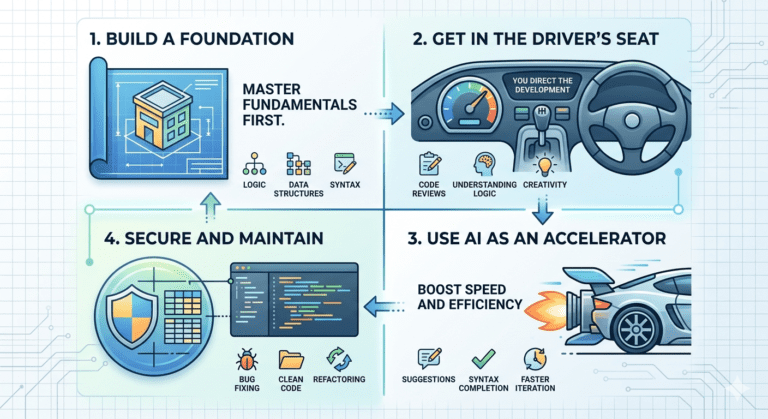

In the current gold rush of Artificial Intelligence, it is tempting to view coding fundamentals—like loops, data structures, and manual debugging—as “legacy” skills. With AI tools capable of generating entire web pages from a single prompt, many beginners are tempted to skip the “boring” part and go straight to the “magic.”
However, using AI without understanding development is like trying to pilot a jet without knowing how to read the instrument panel. You might get off the ground, but you won’t know how to land when the engine stalls.
1. AI is an Assistant, Not a Lead Architect
AI models (like LLMs) are probabilistic, not deterministic. They don’t “know” how to code; they predict which character comes next based on patterns in their training data.
- The Hallucination Problem: AI can confidently suggest libraries that don’t exist or logic that contains subtle security flaws.
- Context Blindness: AI often struggles to understand the “big picture” of a complex project. It might give you a perfect function for a small task that completely breaks the rest of your system.
2. You Can’t Debug What You Don’t Understand
Debugging is 80% of software development. When an AI-generated script fails, it doesn’t give you a polite explanation; it gives you a stack trace full of cryptic errors.
If you haven’t learned the basics of Syntax, Memory Management, and Logic, you will be “stuck in the dark.” Developers who skip the basics often find themselves in a loop of “prompting the AI to fix the AI,” which leads to bloated, messy, and unmaintainable code.
3. The “Explain-It-Back” Test
A common trap for beginners is “Learned Helplessness.” This happens when you become so reliant on a tool that your own problem-solving muscles atrophy.
The Rule of Thumb: If you cannot explain every line of code an AI gives you, you shouldn’t put it in your project.
Why Fundamentals Matter:
| Skill | Why AI Can’t Replace It |
| Logic & Algorithms | AI can give you a solution, but you need to know why it’s efficient (or not). |
| Architecture | Deciding how different parts of a system talk to each other requires human judgment. |
| Security | AI often suggests “easy” code that lacks proper encryption or sanitization. |
| Creativity | AI can only remix what already exists. New, innovative solutions come from humans. |
4. How to Use AI Responsibly While Learning
You don’t have to ignore AI entirely while you learn, but you should change how you use it:
- Instead of: “Write a Python script that scrapes this website.”
- Try: “Explain the logic behind the
BeautifulSouplibrary and show me a simple loop structure for it.” - The “3-Month Rule”: For the first three months of learning, try to write your code manually. Use AI only as a “Tutor” to explain concepts, not as a “Writer” to produce code.
Conclusion: Becoming a “Force Multiplier”
The goal isn’t to compete with AI; it’s to use AI to amplify your skills. A developer who understands the fundamentals and uses AI is a Force Multiplier—they can do the work of three people. A person who only knows AI is just a “Prompt Engineer” whose value disappears the moment the AI makes a mistake.
Master the basics first. Build the foundation. Once you know how the engine works, the AI “turbocharger” will take you further than you ever thought possible.