
Executive Summary: AI’s Double-Edged Reality
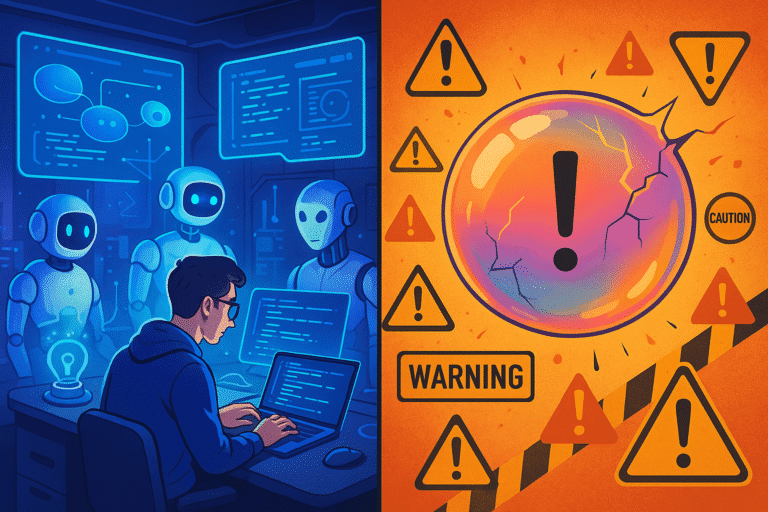
The artificial intelligence market presents a fascinating paradox: while experiencing unprecedented growth and transforming development workflows, it simultaneously shows concerning signs of inflated expectations and implementation failures. For software developers in 2025, the answer isn’t simply “boom or bubble” – it’s both, depending on how you position yourself in this rapidly evolving landscape.
The Impressive Growth Numbers Tell One Story
The AI market’s financial trajectory is undeniably impressive. The global artificial intelligence market reached $638.23 billion in 2024 and is projected to expand to $3.68 trillion by 2034, representing a compound annual growth rate of 19.2%. In the United States alone, the market is expected to grow from $146.09 billion in 2024 to $851.46 billion by 2034.
Venture capital investment reflects this enthusiasm. In Q1 2025, AI captured an extraordinary $59.6 billion globally, representing 53% of all venture funding. This includes mega-rounds like OpenAI’s $40 billion raise and Anthropic’s $4.5 billion funding. AI startups raised $104 billion in the first half of 2025 alone.
The Bubble Warning Signs Are Real
However, beneath these impressive figures lie troubling realities. An MIT study analyzing enterprise AI implementations delivered a stark assessment: 95% of organizations implementing generative AI are achieving zero return on investment. Despite $30-40 billion in enterprise AI investment, only 5% of integrated AI pilots are extracting millions in value.
The disconnect between investment and results is creating what experts call a “reality check moment.” Sam Altman, OpenAI’s CEO, acknowledged that “investors, in general, are overly enthusiastic about AI” and compared current conditions to the dot-com bubble. Tech stocks experienced significant volatility following these revelations, with Nvidia dropping 3.5% and Palantir falling 9% after the MIT study’s release.
The Software Developer Experience: Productivity Gains vs. Trust Deficits
For software developers, AI tools have become ubiquitous yet controversial. According to Stack Overflow’s 2025 Developer Survey, 84% of developers now use or plan to use AI tools, with 51% of professional developers using them daily. However, trust has dramatically declined: only 33% trust AI output accuracy, down from higher levels in previous years, while 46% actively distrust AI-generated code.
Productivity Paradox
The productivity story reveals complex nuances. McKinsey research shows developers can complete coding tasks up to twice as fast with generative AI for certain activities like documentation (50% faster), code generation (nearly 50% faster), and code refactoring (35% faster). AI adoption correlates with a 25% productivity increase and improvements in flow state (+2.6%), job satisfaction (+2.2%), and code quality (+3.4%).
However, real-world implementation challenges persist. A recent study found that experienced developers using AI tools actually took 19% longer to complete tasks than predicted, contradicting their expectation of 24% time savings. The primary issue: 45% of developers report that debugging AI-generated code takes longer than writing it themselves.
Market Correction Signs and Implications
The AI investment landscape shows clear signs of overcorrection. While $131.5 billion was invested globally in AI deals in 2024, exits totaled only $36 billion – indicating far more money flowing in than out. Apollo Global Management’s chief economist argues that AI valuations could exceed the internet bubble, with the top 10 S&P 500 companies more overvalued than during the dot-com era.
Revenue multiple-based valuations are proving inadequate for AI companies facing “compute costs that scale super-linearly with model size and usage”. Unlike traditional software with near-zero marginal costs, AI companies face GPU bills that can grow faster than revenue, demanding more sophisticated cash flow analysis.
Developer Job Market: Transformation, Not Elimination
Despite bubble concerns, the software development job market remains fundamentally strong. The Bureau of Labor Statistics projects 17% growth for software developers from 2023-2033, adding approximately 327,900 new jobs. However, the nature of roles is evolving significantly.
High-demand areas include:
- AI research scientists (80% job growth since 2023)youtube
- Machine learning engineers (70% growth)youtube
- Developers with cloud and AI expertise
Declining demand affects:
- Mobile engineers (-20%)youtube
- Frontend developers (-20%)youtube
- Entry-level positions (now just 7% of big tech hires, down 25% from 2023)
Companies like Salesforce are explicitly stating they’re “hiring fewer software engineers due to productivity gains from artificial intelligence”. However, this reflects role evolution rather than elimination – developers are increasingly expected to leverage AI tools effectively.
The Developer Skill Evolution
The most successful developers are adapting to AI as a collaborative tool rather than viewing it as a threat. Key trends include:
AI Tool Mastery: GitHub Copilot usage has become standard, with 55% of professional developers using AI-powered code suggestions regularly. Newer tools like Cursor are gaining traction for their superior codebase awareness and faster response times (320ms vs 890ms).
Focus Shift: Developers are moving from routine coding to higher-level design, architecture decisions, complex problem-solving, and AI system integration. The most valuable developers combine domain expertise with AI tool proficiency.
Continuous Learning: 69% of developers spent time learning new coding techniques in the past year, with 44% using AI-enabled tools for learning. This represents a fundamental shift toward AI-augmented skill development.
Strategic Recommendations for Developers
1. Embrace AI as a Productivity Multiplier
Rather than fearing replacement, view AI tools as productivity accelerators. Focus on mastering tools like GitHub Copilot, Cursor, or Claude for code generation, documentation, debugging, and learning new technologies. The developers who thrive will be those who most effectively combine human creativity with AI efficiency.
2. Develop AI-Adjacent Skills
Position yourself for high-demand roles by developing expertise in:
- Machine learning model implementation and deployment
- AI system architecture and integration
- Prompt engineering and AI tool optimization
- AI ethics and bias detection
- Data pipeline and infrastructure management
3. Focus on Complex, Creative Problem-Solving
AI excels at routine tasks but struggles with complex system design, architectural decisions, business requirement interpretation, and creative problem-solving. Develop expertise in areas requiring human judgment, contextual understanding, and strategic thinking.
4. Stay Platform-Agnostic
Avoid building your career around single AI platforms or tools. Focus on fundamental programming principles, system design skills, and adaptability that transfer across technologies. The AI landscape will continue evolving rapidly.
5. Understand Business Value Creation
The most valuable developers understand not just how to use AI tools, but when and why to use them. Develop skills in measuring AI impact, cost-benefit analysis, and business outcome optimization.
The Verdict: Selective Boom with Bubble Characteristics
AI represents both a genuine technological revolution and a market bubble – these aren’t mutually exclusive. The technology is delivering real productivity gains and creating new opportunities, but valuations and expectations have clearly outpaced current capabilities in many areas.
For software developers, the key insight is selectivity. Companies and developers who approach AI strategically – focusing on proven use cases, sustainable economics, and genuine value creation – will thrive. Those chasing hype or building “thin wrapper” solutions will likely face disappointment as the market matures.
The AI transformation is real and permanent, but the current frenzy will moderate. Developers who position themselves as AI-augmented problem solvers rather than AI-dependent code generators will build the most durable and valuable careers in this evolving landscape.
The future belongs to developers who can harness AI’s power while maintaining the human skills that remain irreplaceable: creative problem-solving, strategic thinking, system design, and business value creation. The question isn’t whether AI will change software development – it already has. The question is whether you’ll adapt to lead that change or be left behind by it.